
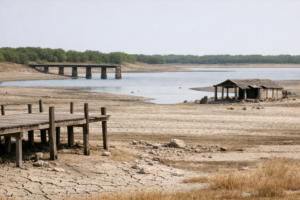

Dwindling reservoir levels across South Texas have triggered a rapid shift toward groundwater extraction, raising urgent concerns about long-term water security. In the Corpus Christi region, officials and residents now face a growing crisis as aquifers are tapped at unprecedented rates to sustain households, agriculture, and heavy industry.
Reservoir Decline Sparks Groundwater Rush
After years of extreme heat and persistent drought, surface water sources that once sustained the region have dropped to critically low levels. As a result, cities, ranchers, and industrial operators have turned to underground reserves such as the Evangeline Aquifer.
Local authorities have already begun pumping millions of gallons per day to delay projected shortages. While these emergency measures have temporarily extended supply timelines, they have also intensified pressure on fragile groundwater systems.
Rural Communities Feel Immediate Impact
Residents in nearby counties report declining well levels and rising costs. In rural Jim Wells County, families who depend on private wells have experienced sudden water disruptions. Some landowners have had to deepen their wells or drill new ones, often at significant personal expense.
At the same time, environmental changes have become increasingly visible. Dry pastures, shrinking ponds, and even dunes highlight the severity of the drought. For ranchers, the lack of water directly threatens livestock and livelihoods.
Industrial Demand Complicates Supply
The region’s industrial sector adds another layer of complexity. Large-scale facilities, including petrochemical plants and refineries, consume substantial volumes of water daily. As supply tightens, these users are also seeking alternative sources, including private wells.
Notably, a major plastics facility operated by ExxonMobil has explored groundwater options, though some test wells yielded water that was too saline for use. Despite these setbacks, industrial demand continues to rise, intensifying competition for limited resources.
Massive Pumping Projects Underway
To stabilize supply, multiple wellfields are under development along the Nueces River. These projects aim to extract tens of millions of gallons per day in the coming months.
However, experts warn that planned withdrawals could exceed sustainable limits by a wide margin. In some cases, projected pumping rates surpass state recommendations by more than 1,000 percent, raising concerns about long-term aquifer depletion.
Rising Salinity Creates New Challenges
As groundwater extraction accelerates, water quality has emerged as a critical issue. Many wells in the region produce brackish water, which requires costly treatment through reverse osmosis systems.
Smaller communities, such as Orange Grove and Beeville, are already grappling with rising salinity levels. In some cases, water quality is approaching thresholds that could make it unsafe for consumption.
Costly Infrastructure Strains Small Towns
To address these challenges, cities are investing heavily in treatment infrastructure. Beeville, for example, has approved a multimillion-dollar bond to fund a desalination project. Meanwhile, other towns are exploring partnerships or legal options to secure safe water supplies.
For smaller municipalities with limited budgets, these solutions may not be financially feasible. As a result, disparities in access to clean water could widen across the region.
Water Restrictions Loom for All Users
With demand continuing to outpace supply, officials in Corpus Christi are preparing contingency plans. These include potential reductions in water usage across residential, commercial, and industrial sectors.
City leaders have proposed a 25 percent cut in consumption if conditions worsen. Importantly, these restrictions may extend to industrial users, who collectively account for nearly half of the region’s water use.
Legal and Policy Questions Remain
Implementing such reductions could prove contentious. Existing contracts with industrial users may complicate enforcement, potentially leading to legal disputes. Nevertheless, city officials maintain that emergency provisions allow them to reallocate water if necessary.
Without significant rainfall in the coming months, experts believe mandatory curtailment is increasingly likely.
Long-Term Planning Failures Exposed
While drought has accelerated the crisis, analysts point to deeper structural issues. Rapid industrial expansion over the past decade has significantly increased water demand, yet infrastructure development has not kept pace.
Efforts to build alternative sources, including desalination plants, faced delays and shifting priorities. As a result, the region entered this drought cycle without sufficient backup systems in place.
Lessons from Past Water Projects
Decades ago, Corpus Christi responded to a similar drought by constructing the Mary Rhodes Pipeline, a major infrastructure project that continues to supply water today. However, comparable large-scale solutions have not materialized in recent years.
Water policy experts argue that Texas has long underestimated future demand. With population growth and industrial activity rising, the gap between supply and consumption has widened steadily.
A Race Against Time
Today, the region is effectively “drilling its way” through the crisis. Emergency groundwater projects have bought valuable time, but they come with high environmental and economic costs.
Officials acknowledge that current measures are not sustainable in the long term. Without rainfall or new infrastructure, the risk of severe shortages remains high.
The situation shows residents, businesses, and policymakers a stark reality: they can no longer take water security for granted.