
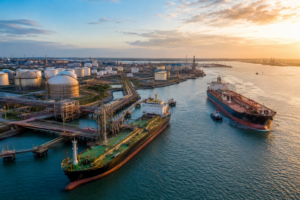

The Port of Corpus Christi is experiencing an unprecedented boom as global oil tankers flood the U.S. Gulf Coast amid ongoing disruptions caused by the Iran war. With major Middle Eastern export routes heavily restricted, buyers across Asia and other regions are increasingly turning to the United States for crude oil supplies.
As a result, the Texas port has become one of the most critical energy hubs in the global oil market.
Global Oil Trade Shifts to the U.S.
Before the conflict intensified, the Port of Corpus Christi already ranked as the world’s third-largest crude oil export terminal, trailing only the major facilities at Ras Tanura in Saudi Arabia and Basra in Iraq. However, the closure of shipping routes through the Strait of Hormuz has significantly elevated the port’s global importance.
According to energy analytics firm Kpler, U.S. crude oil exports surged to 5.2 million barrels per day in April. That marks a more than 30% increase from the 3.9 million barrels per day exported in February before the conflict escalated.
The Strait of Hormuz, one of the world’s most important maritime oil corridors, previously handled roughly 20% of global oil shipments. Iran’s blockade has severely disrupted access to Persian Gulf ports, forcing buyers and shipping companies to seek alternative suppliers.
Consequently, the U.S. Gulf Coast has become a primary destination for crude oil trade.
Record Activity at Corpus Christi
The Port of Corpus Christi recorded its busiest month ever in March, followed by its strongest first quarter on record. Port CEO Kent Britton said oil exports from the facility climbed to approximately 2.5 million barrels per day since the war began, compared to 2.2 million barrels per day during the same period last year.
Additionally, vessel traffic increased dramatically. More than 240 ships entered the port in March, well above the usual monthly average of around 200 vessels.
Britton described the activity as nonstop.
Tanker Traffic Doubles
Very Large Crude Carriers, commonly known as VLCCs, are arriving at U.S. ports at historic levels. Data from Kpler shows that between 50 and 60 VLCCs are now heading toward American export terminals on any given day, nearly double last year’s volume.
These massive vessels can carry up to 2 million barrels of crude oil each, making them essential for long-distance international exports.
Corpus Christi alone accounted for roughly half of all U.S. crude oil exports in April, while Houston handled most of the remaining shipments.
Asian Buyers Turn to U.S. Oil
Asian countries previously relied heavily on Middle Eastern crude supplies. However, shipping restrictions through the Strait of Hormuz have forced many importers to pivot toward American oil producers.
Matt Smith, director of commodity research at Kpler, said Asian markets are aggressively securing available supplies from the United States.
Demand for Light Sweet Crude Rises
Many Asian buyers are purchasing light sweet crude from the U.S. Gulf Coast because of limited access to Middle Eastern barrels. While this type of crude differs from the heavier sour crude commonly exported by Gulf nations, buyers are prioritizing availability over refinery optimization during the crisis.
In addition to crude oil, exports of refined petroleum products from Corpus Christi to the Middle East have also surged. Britton noted that first-quarter refined product exports to the region already exceeded all exports recorded during the previous year.
The trend highlights how the ongoing conflict is reshaping global energy trade patterns.
Infrastructure Limits Could Slow Growth
Despite the export boom, industry analysts believe infrastructure constraints may soon limit U.S. oil shipments.
Smith explained that American crude exports are likely capped slightly above 5 million barrels per day because of limited dock and loading capacity. Although Corpus Christi can currently export around 2.6 million barrels per day, pipeline bottlenecks continue to restrict additional growth.
Britton said the port could potentially handle another 500,000 barrels daily if pipeline infrastructure expands in the future.
Middle East Still Dominates Global Supply
Even with rising exports from the United States, analysts caution that American production cannot fully replace Middle Eastern oil supplies.
Many international refineries specifically process heavier crude grades from the Persian Gulf. As a result, U.S. light sweet crude serves only as a temporary substitute during supply disruptions.
Smith added that additional supplies from Latin America and West Africa may help temporarily offset shortages. However, the scale of Middle Eastern oil production remains unmatched.
Ultimately, global energy stability still depends heavily on secure access to shipping through the Persian Gulf.
Oil Market Faces Continued Uncertainty
The surge in activity at the Port of Corpus Christi reflects how quickly geopolitical tensions can reshape international trade flows. While U.S. exporters are benefiting from soaring demand, experts believe the current shift may be more of a wartime adjustment than a permanent restructuring of the oil market.
Nevertheless, the ongoing crisis has reinforced the strategic importance of American energy infrastructure and highlighted the vulnerability of global supply chains tied to the Middle East.
As tanker traffic continues rising and oil buyers search for stable supply routes, Corpus Christi remains at the center of one of the biggest energy shifts in recent years.