
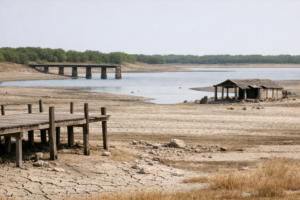

Lake Corpus Christi Reaches Historic Lows
The rapidly shrinking shoreline of Lake Corpus Christi has exposed vast stretches of dry lakebed, leaving docks stranded and long-submerged structures visible once again. What was once a vital water source now resembles a barren landscape.
During a recent visit, resident Isabel Araiza described the transformation as surreal. She noted that some areas look more like open fields than a reservoir. Her reaction reflects growing concern among residents as water levels continue to plummet.
Currently, Lake Corpus Christi holds just over 9% of its total capacity. Meanwhile, Choke Canyon Reservoir has dropped below 8%, and Lake Texana remains at roughly half capacity. Together, these reservoirs supply water to Corpus Christi, making the situation increasingly urgent.
Drought and Demand Push City Toward Crisis
Five-Year Drought Intensifies Pressure
A prolonged five-year drought has significantly reduced rainfall across the region. As a result, water reserves have failed to recover, pushing the city closer to emergency conditions.
City officials warn that, within months, Corpus Christi could face strict water-use restrictions. Without intervention, declining supply may disrupt daily life and economic activity.
Industrial Water Use Under Scrutiny
Corpus Christi’s economy relies heavily on petrochemical plants, refineries, and steel manufacturing facilities. These industries require massive volumes of water for cooling systems and refining processes.
In fact, just 12 companies account for approximately 55% of the city’s water consumption. This concentration has intensified debate over resource allocation, especially as residential users face increasing restrictions.
Recent industrial expansion has further strained supply. New facilities, including projects involving ExxonMobil and SABIC, were approved with expectations of reliable water access. However, those projections relied heavily on future infrastructure that has yet to materialize.
Desalination Debate Gains Urgency
Delayed Projects Raise Concerns
Officials have long viewed the proposed desalination plant as a key solution. Designed to convert seawater into freshwater, the project could provide a drought-resistant supply.
However, rising costs—from $757 million to $1.3 billion—led city leaders to cancel the plan last year. Now, worsening conditions have forced officials to reconsider.
City officials will soon present a new proposal to the city council, signaling renewed urgency.
Benefits and Environmental Trade-Offs
Desalination offers a reliable alternative in coastal regions like Corpus Christi. Still, the process comes with challenges. It requires significant energy and produces concentrated brine that may affect marine ecosystems.
Residents have voiced concerns about potential environmental damage to local waters, which support diverse wildlife. However, city officials maintain that studies show minimal long-term impact.
Policy Tensions and Political Pressure
The crisis has drawn sharp criticism from Greg Abbott, who accused city leadership of mismanaging water funding. He suggested that state intervention may be necessary to ensure supply stability.
In response, city officials stated that funding allocated for desalination remains available and that long-term planning efforts are ongoing. Over the past year, Corpus Christi has approved $1 billion in financing for additional water projects, including groundwater development.
Despite these efforts, disagreements persist over accountability and next steps.
Residents Face Restrictions as Crisis Looms
Water Rules Tighten for Households
Residents already face fines for excessive water use, including violations of lawn watering rules. These measures aim to conserve limited resources as reservoir levels continue to fall.
However, frustration is growing. Many residents argue that while households must cut usage, industrial consumption remains largely unchanged.
Emergency Measures on the Horizon
City officials recently outlined a worst-case scenario: a Level 1 water emergency as early as May. Under such conditions, all users—residential and industrial—would need to reduce consumption by 25%.
Enforcing these cuts presents logistical challenges, particularly for industries that depend on a continuous water supply to operate.
Searching for Short- and Long-Term Solutions
To ease immediate pressure, state leaders have temporarily adjusted water withdrawal rules and expedited permits for alternative sources. Meanwhile, some companies are investing in water recycling initiatives to reduce dependence on freshwater.
Still, most solutions remain in development. New desalination facilities and groundwater projects could take years to complete, leaving the city vulnerable in the short term.
A Warning for Water-Stressed Cities
Corpus Christi’s situation highlights a broader global issue: the growing conflict between industrial growth and limited natural resources. As climate change intensifies drought conditions, similar challenges are likely to emerge in other regions.
Experts emphasize the need for diversified water strategies that account for uncertainty. Relying solely on rainfall and existing reservoirs is no longer sufficient.
Ultimately, the crisis underscores a difficult balancing act—supporting economic development while ensuring sustainable access to water for residents.